Personal Cassette Players. Portable CD players. Dial up Internet. Betamax. The VCR. Pagers. These are all popular technologies that have gone away. When they were hot, you would never have expected for them to one day be extinct. Are blade servers set to follow in the footsteps of these other blade technologies?
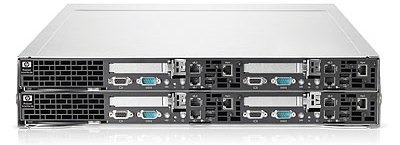 Mid year of 2009, HP introduced their “scalable” line of servers with the HP ProLiant SL6000 family that provided users with the ability to have 4 Intel based servers inside of a 2U form factor. Designed to be a low cost compute power offering, the HP ProLiant SL6000 was my first glimpse into what could be the beginning of the end of blade servers. Why? The SL6000 family shared power and cooling – just like blade servers. I’m not sure if the scalable line of HP ProLiant servers has been a huge success (or a failure) but offers it gives HP another way to reach out to customers’ needs.
Fast forward to 2010. Dell introduces the Dell PowerEdge C Server line. 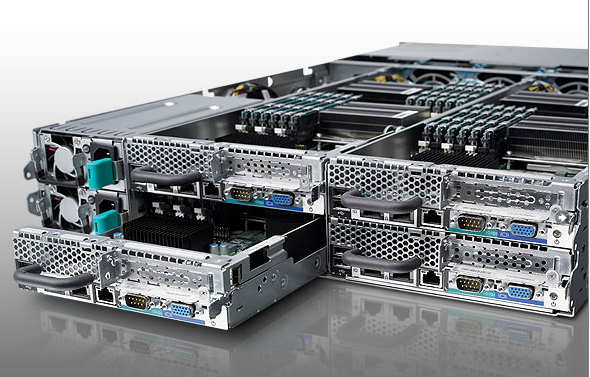 Geared toward cloud computing, Web 2.0 environments and high performance computing (HPC), the PowerEdge C Server appeared to compete head to head with the HP ProLiant SL family. Like the HP offering, the Dell PowerEdge C Servers offered multiple server nodes in a small, 2U footprint with shared cooling and power. From a competitive comparison, there are probably a few differences, but overall they are close enough to be equal.
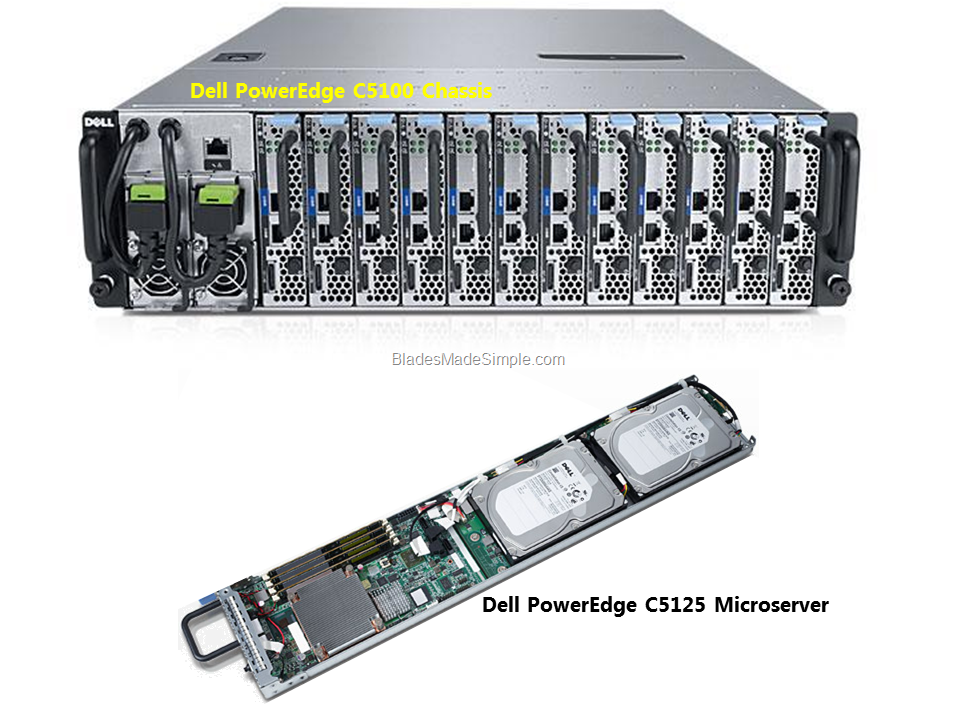 A few weeks ago, Dell covertly released a new offering to their PowerEdge C Server line that pushes the border between blade servers and “scalable” rack server. The Dell PowerEdge C5000 Chassis, coupled with Dell PowerEdge C5125 Microserver offers the ability to have 12 compute nodes within a 3U space. This means in a 42U rack, the PowerEdge C5100 line could provide 672 cores of Intel CPUs. The Dell PowerEdge C5125 “microserver” is just that – a micro server that is limited to 1 single CPU, 4 memory DIMMs and up to 4 x 2.5” drives. It’s not a powerhouse server, but it provides CPU compute power. To put this into perspective, Dell’s M610 blade server maxes out at 768 cores per 42u rack. As you can see, the Dell PowerEdge C5000 family offers a very close comparison using scaled back microservers.
Hopefully, you can see my point of view of this blog post. We now have manufacturers offering higher density servers sharing power and cooling in a small footprint which infringes on some of the value that blade servers bring. Will this be the end of blade servers, probably not, but as technology continues to advance, maybe one day we’ll have one design offering the best of both the rack server and blade server worlds. One day.
Great post, as usual, Kevin. The waves of compute eras come closer and closer together. I predict that few VARs will be selling servers in the next 10 years as cloud becomes ubiquitous. Those who do sell servers will sell them by the thousands in the form factor you discuss here. But I could be wrong. It could happen much faster.
Whether blades are “dying” or “growing” might hinge on the definition of “blade”.
If blade = servers can be mechanically stuck together and share power and cooling, then both the C5000 microservers and M1000e-based PowerEdge servers are both blades.
So while we once assumed blade architectures included shared networking and beefy nodes, blades have now forked into multiple categories:
* Shared networking + few beefy nodes: e.g. M1000e, BC-H, c7000.
* No shared networking + few beefy nodes: e.g. SL6000.
* Shared networking + many lightweight nodes: e.g. SeaMicro’s Atom servers
* No shared networking + many lightweight nodes: e.g. C5000.
Pingback: Kevin Houston
Pingback: Brent Quick
Pingback: Mark S A Smith
Pingback: Mark S A Smith
Pingback: Evil Stu
Pingback: B. Riley
One day we’ll have one design offering the best of both the rack server and blade server worlds? That would mean that there is potentially a common design which fulfills every customer need. Which, in turn, implies that customer needs are close enough to be met with a single platform. Maybe I’m just not visionary enough, but I have my serious doubts.
Disclaimer: My name is Marc Schreiber, I work for Dell and this is just my personal opinion.
I think not. All these new systems are variants on the blade server form factor
and ideas… It is more evolution in progress than anything else..
Very interesting…
How those servers can be connected to FC SAN?
I mean, I can’t see where FC HBA can be inserted…
Speaking of “servers” only, you´re probably right. But we have to remember of I/O switches and management! And you have a really good point about them.. as you showed on the last post!
Big fan from Brazil.
Pingback: korematic
I would agree. I think this is more of evolution than of replacement. Imagine what happens when you put a ‘Flex-10″ FC HBA on the back of this…..
Brad Bethune
http://www.venderepartners.com
Well, since there isn’t a Flex-10 FC HBA today (and FlexFabric can only add 2 HBA’s max), I’ll instead imagine it with a Cisco UCS Palo card which can give me 58 interfaces which can be ethernet or FC…(disclaimer: no surprise, but I work for Cisco)
Kevin,
The main problem I see here is “high-density-servers-sharing-power-and-cooling-madesimple.com” is really going to be too hard to type :)
The end of blade servers will come when we stop thinking of computing hosts in terms of “servers” and can deliver services through a chassis with stacks/blades/cards of CPU/RAM/network that can all be scaled independently and carved up into hosts/servers/VMs. Now that would be something…
These are evolutionary to the removal of Ethernet as a backbone.
Most come with IB onboard and that is where the power is. Multiple simple compute nodes brought together on an IB grid which provides virtual links to any I/O required (10 GbE, 1 GbE, FC, iSCSI, etc.).
FC isn’t suitable for this kind of product. FCoE maybe, but most likely NFS or iSCSI if you are using Ethernet. Most of these have internal spindles for better performance.
Pingback: Mary Berg - Dell
Pingback: Mary Berg - Dell
Pingback: Blades Made Simple™ » Blog Archive » The End of Blade Servers? | IBM Server Reviews