Artificial Intelligence is quickly becoming another enterprise workload that infrastructure teams have to support. Whether it’s AI inference, model fine-tuning, VDI, rendering, or other GPU-intensive applications, organizations need access to powerful GPUs without building an entirely separate server infrastructure. That’s where the new Cisco UCS X580p PCIe Node comes in. Let’s take a look at the new X580p PCIe node.
What is the Cisco UCS X580p?
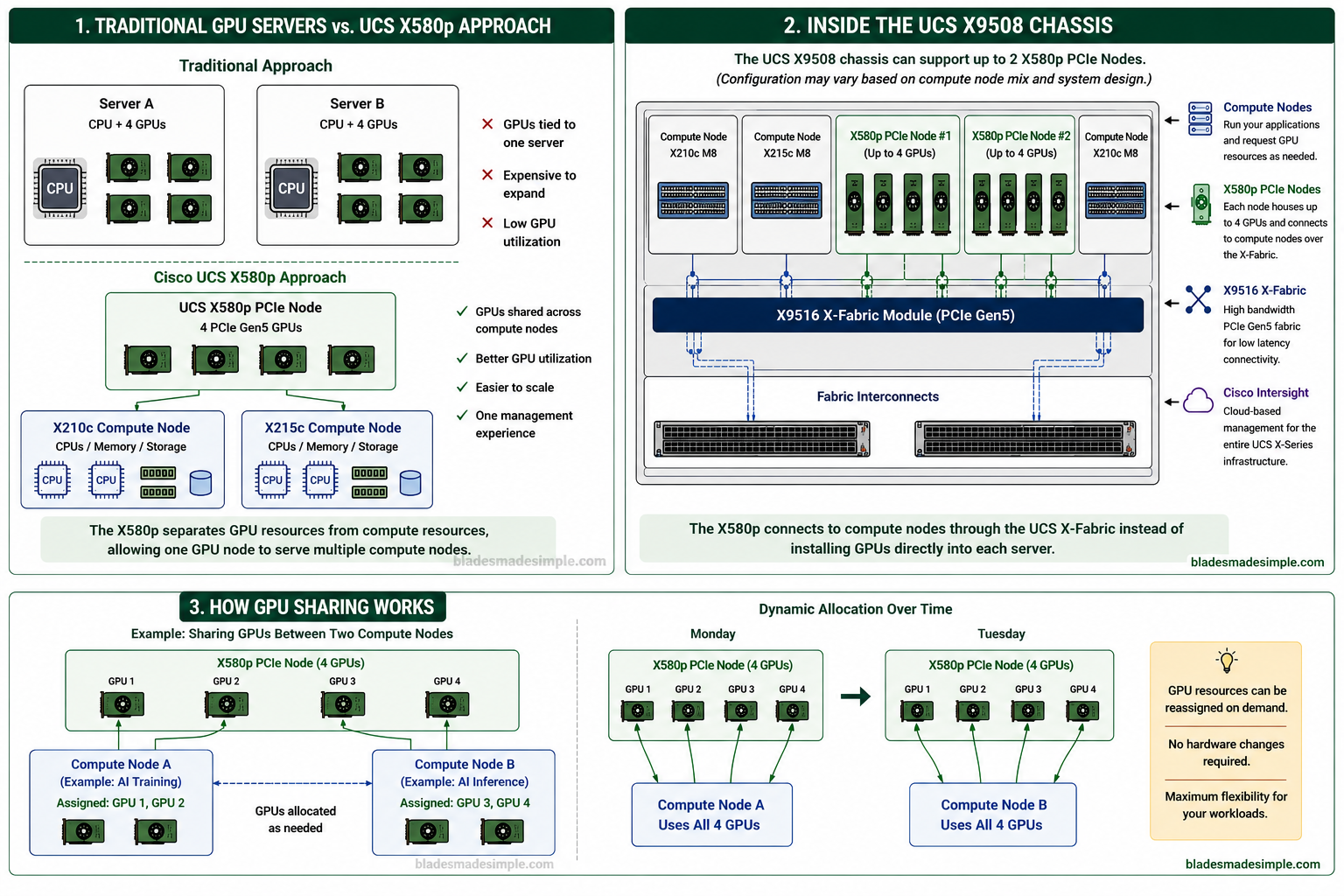
The Cisco UCS X580p PCIe Node is the second-generation PCIe expansion node for the Cisco UCS X-Series Modular System. It is a dedicated GPU enclosure that slides into the UCS X9508 chassis. Instead of adding GPUs directly into every compute node, the X580p houses up to four PCIe Gen5 GPUs that can be assigned to one or two compute nodes as needed.
Recommended Workloads
Cisco designed the X580p for workloads that benefit from GPU acceleration, including:
- Generative AI inference
- AI model fine-tuning
- Machine Learning
- Virtual Desktop Infrastructure (VDI)
- Rendering
- Visualization
- Engineering applications
- Legacy applications that leverage GPU acceleration
Hardware Highlights
Some of the key capabilities include:
- Up to 4 PCIe Gen5 x16 full-height, full-length GPUs
- NVIDIA RTX PRO 4500 Blackwell
- NVIDIA RTX PRO 6000 Blackwell
- NVIDIA H200 NVL
- NVIDIA L40S GPUs
- PCIe Gen5 connectivity
- NVIDIA NVLink support for supported GPU configurations
As newer GPU generations become available, Cisco expects the platform to support future NVIDIA GPUs as well.
Power Requirements
The X580p does not have its own power supplies. It is powered entirely by the Cisco UCS X9508 chassis power subsystem.
The node can consume up to 2400 W, depending on the GPU configuration.
Cisco also specifies a power cap of 1300 W for supported operating configurations and recommends using the Cisco UCS Power Calculator for sizing a particular deployment.
GPU power varies significantly by model. For example:
-
- RTX PRO 4500: 185 W
- L40S: 350 W
- H200 NVL: 600 W
- RTX PRO 6000 Blackwell: 600 W
Works with Existing UCS X-Series
The X580p isn’t a standalone product.
It integrates into the existing UCS X-Series ecosystem, including:
- Cisco UCS X9508 Chassis
- Cisco UCS X9516 X-Fabric Modules
- Cisco UCS X210c M8 Compute Nodes
- Cisco UCS X215c M8 Compute Nodes
- Cisco Intersight for centralized management
If you’re already invested in UCS X-Series, adding GPU capability becomes an extension of your existing environment rather than deploying another infrastructure platform.
Final Thoughts
The Cisco UCS X580p isn’t simply “a server with GPUs.”
It’s a modular GPU resource designed to fit naturally into the UCS X-Series architecture.
If your organization is already running UCS X-Series and beginning to explore AI, machine learning, VDI, or visualization workloads, the X580p provides a straightforward path to GPU acceleration while preserving the management and operational model you’re already familiar with.
For many organizations, that’s likely its biggest advantage—not just adding GPUs, but adding them without adding another infrastructure silo.
Find out more about the Cisco UCS x580p here.
 Kevin Houston is the founder of BladesMadeSimple.com. With over 29 years of experience in the x86 server marketplace Kevin has a vast array of competitive x86 server knowledge and certifications as well as an in-depth understanding of VMware virtualization. He has worked at Dell Technologies since August 2011 and is a Principal Technologist supporting the Central Enterprise Region and is also a CTO Ambassador for the Office of the CTO at Dell Technologies.. #IWork4Dell
Disclaimer: The views presented in this blog are personal views and may or may not reflect any of the contributors’ employer’s positions. Furthermore, the content is not reviewed, approved or published by any employer. No compensation has been provided for any part of this blog.