Tag Archives: Intel

Cisco, EMC and VMware Announcement – My Thoughts


By now I’m sure you’ve read, heard or seen Tweeted the announcement that Cisco, EMC and VMware have come together and created the Virtual Computing Environment coalition .   So what does this announcement really mean?  Here are my thoughts:

Greater Cooperation and Compatibility
Since these 3 top IT giants are working together, I expect to see greater cooperation between all three vendors, which will lead to understanding between what each vendor is offering.  More important, though, is we’ll be able to have reference architecturethat can be a starting point to designing a robust datacenter.  This will help to validate that an “optimized datacenter” is a solution that every customer should consider.

Technology Validation
With the introduction of the Xeon 5500 processor from Intel earlier this year and the announcement of the Nehalem EX coming early in Q1 2010, the ability to add more and more virtual machines onto a single host server is becoming more prevalent.  No longer is the processor or memory the bottleneck – now it’s the I/O.  With the introduction of Converged Network Adapters (CNAs), servers now have access to  Converged Enhanced Ethernet (CEE) or DataCenter Ethernet (DCE) providing up to 10Gb of bandwidth running at 80% efficiency with lossless packets.  With this lossless ethernet, I/O is no longer the bottleneck.

VMware offers the top selling virtualization software, so it makes sense they would be a good fit for this solution.

Cisco has a Unified Computing System that offers up the ability to combine a server running a CNA to a Interconnect switch that allows the data to be split out into ethernet and storage traffic.  It also has a building block design to allow for ease of adding new servers – a key messaging in the Coalition announcement.

EMCoffers a storage platform that will enable the storage traffic from the Cisco UCS 6120XP Interconnect Switch and they have a vested interest in VMware and Cisco, so this marriage of the 3 top IT vendors is a great fit.

Announcement of Vblock™ Infrastructure Packages
According to the announcement, the Vblock Infrastructure Package “will provide customers with a fundamentally better approach to streamlining and optimizing IT strategies around private clouds.”  The packages will be fully integrated, tested, validated, and that combine best-in-class virtualization, networking, computing, storage, security, and management technologies from Cisco, EMC and VMware with end-to-end vendor accountability.  My thought on these packages is that they are really nothing new.  Cisco’s UCS has been around, VMware vSphere has been around and EMC’s storage has been around.  The biggest message from this announcement is that there will soon be  “bundles” that will simplify customers solutions.  Will that take away from Solution Providers’ abilities to implement unique solutions?  I don’t think so.  Although this new announcement does not provide any new product, it does mark the beginning of an interesting relationship between 3 top IT giants and I think this announcement will definitely be an industry change – it will be interesting to see what follows.

UPDATE – click here check out a 3D model of the vBlocks Architecture.

What Gartner Thinks of Cisco, HP, IBM and Dell (UPDATED)

(UPDATED 10/28/09 with new links to full article)

I received a Tweet from @HPITOps linked to Gartner’s first ever “Magic Quadrant” for blade servers.  Gartner Magic Quadrant - October 2009The Magic Quadrant is a tool that Gartner put together to help people easily where manufacturers rank, based on certain criteria.  As the success of blade servers continues to grow, the demand for blades increases.  You can read the complete Gartner paper at http://h20195.www2.hp.com/v2/getdocument.aspx?docname=4AA3-0100ENW.pdf, but I wanted to touch on a few highlights.

Key Points

  • *Blades are less than 15% of the server marketplace today.
  • *HP and IBM make up 70% of the blade market share
  • *HP, IBM and Dell are classified as “Leaders” in the blade market place and Cisco is listed as a “Visionary” 

What Gartner Says About Cisco, Dell, HP and IBM

Cisco
Cisco announced their entry into the blade server market place in early 2009 and as of the past few weeks began shipping their first product.  Gartner’s report says, “Cisco’s Unified Computing System (UCS) is highly innovative and is particularly targeted at highly integrated and virtualized enterprise requirements.”  Gartner currently views Cisco as being in the “visionaries” quadrant.  The report comments that Cisco’s strengths are:

  • they have a  global presence in “most data centers”
  • differentiated blade design
  • they have a cross-selling opportunity across their huge install base
  • they have strong relationships with virtualization and integration vendors

As part of the report, Gartner also mentions some negative points (aka “Cautions”) about Cisco to consider:

  • Lack of blade server install base
  • limited blade portfolio
  • limited hardware certification by operating system and application software vendors

Obviously these Cautions are based on Cisco’s newness to the marketplace, so let’s wait 6 months and check back on what Gartner thinks.

Dell
No stranger to the blade marketplace, Dell continues to produce new servers and new designs.  While Dell has a fantastic marketing department, they still are not anywhere close to the market share that IBM and HP split.  In spite of this, Gartner still classifies Dell in the “leaders” quadrant.  According to the report, “Dell offers Intel and AMD Opteron blade servers that are well-engineered, enterprise-class platforms that fit well alongside the rest of DelI’s x86 server portfolio, which has seen the company grow its market share steadily through the past 18 months.

The report views that Dell’s strengths are:

  • having a cross-selling opportunity to sell blades to their existing server, desktop and notebook customers
  • aggressive pricing policies
  • focused in innovating areas like cooling and virtual I/O

Dell’s “cautions” are reported as:

  • having a limited portfolio that is targeted toward enterprise needs
  • bad history of “patchy committment” to their blade platforms

It will be interesting to see where Dell takes their blade model.  It’s easy to have a low price model on entry level rack servers, but in a blade server infrastructure where standardization is key and integrated switches are a necessity having the lowest pricing may get tough.

IBM
Since 2002, IBM has ventured into the blade server marketplace with an wide variety of server and chassis offerings.  Gartner placed IBM in the “leaders” quadrant as well, although they place IBM much higher and to the right signifying a “greater ability to execute” and a “more complete vision.”  While IBM once had the lead in blade server market share, they’ve since handed that over to HP.  Gartner reports, “IBM is putting new initiatives in place to regain market share, including supply chain enhancements, dedicated sales resources and new channel programs. 

The report views that IBM’ strengths are:

  • strong global market share
  • cross selling opportunities to sell into existing IBM System x, System i, System p and System z customers
  • broad set of chassis options that address specialized needs (like DC power & NEBS compliance for Telco) as well as Departmental / Enterprise
  • blade server offerings for x86 and Power Processors
  • strong record of management tools
  • innovation around cooling and specialized workloads

Gartner only lists one “caution” for IBM and that is their loss of market share to HP since 2007.

HP
Gartner identifies HP as being in the farthest right in the October 2009 Magic Quadrant, therefore I’ll classify HP as being the #1 “leader.”  Gartner’s report says, “Since the 2006 introduction of its latest blade generation, HP has recaptured market leadership and now sells more blade servers than the rest of the market combined.”  Ironically, Gartner list of HP’s strengths is nearly identical to IBM:

  • global blade market leader
  • cross selling opportunities to sell into existing HP server, laptop and desktop customers
  • broad set of chassis options that address Departmental and Enterprise needs
  • blade server offerings for x86 and Itanium Processors
  • strong record of management tools
  • innovation around cooling and virtual I/O

Gartner only lists one “caution” for HP and that is their portfolio, as extensive as it may be, could be considered too complex and it could be too close to HP’s alternative, modular, rack-based offering.

Gartner’s report continues to discuss other niche players like Fujitsu, NEC and Hitachi, so if you are interesting in reading about them, check out the full report at 

http://h20195.www2.hp.com/v2/getdocument.aspx?docname=4AA3-0100ENW.pdf.  All-in-all, Gartner’s report reaffirms that HP, IBM and Dell are the market leaders, for now, with Cisco coming up behind them.

Feel free to comment on this post and let me know what you think.

estimated tax payments
christmas tree store
beaches in florida
dog treat recipes
new zealand map

HP's Well Hidden Secret Blade Server

bl2x220cg5

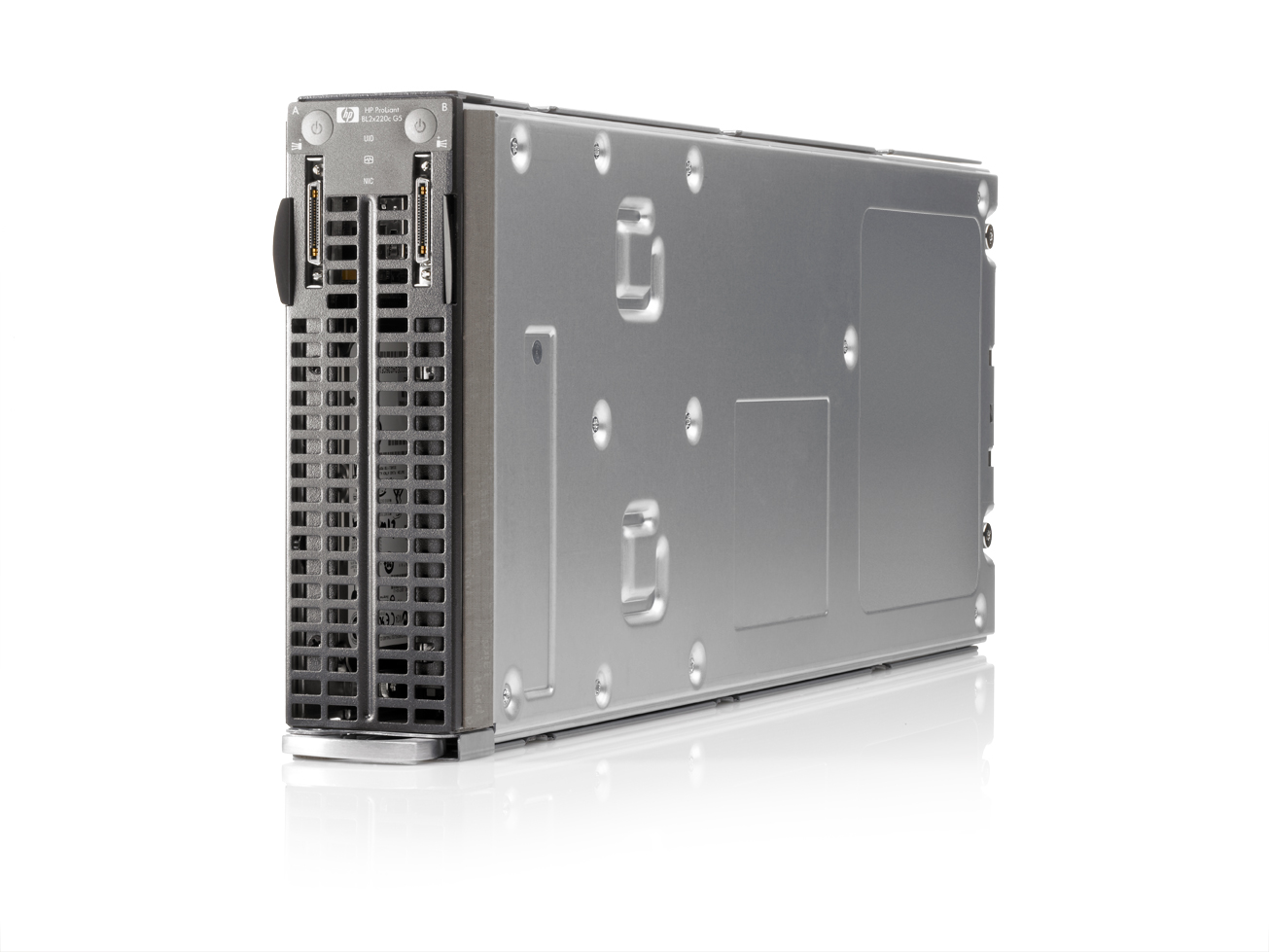
BL2x220c G5 (2 server "nodes" shown)

HP’s BladeSystem server offering is quite extensive – everything from a 4 CPU Intel blade to an Itanium CPU blade, however their most well hidden, secret blade is their BL2x220c blade server.  Starting at $6,129, this blade server is an awesome feet of design because it is not just 1 server, it is 2 serversin 1 blade case – in a clam shell design (see below).  This means that in a HP C7000 BladeSystem chassis you could have 32 servers!    That’s 64 CPUs, 256 CORES, 2TB of RAM all in a 10U rack space.  That’s pretty impressive.  Let me break it down for you.  Each “node” on a single 2 node BL2x220c G5 server contains:

  • Up to two Quad-Core Intel® Xeon® 5400 sequence processors
  • Up to 32 GB (4 x 8 GB) of memory, supported by (4) slots of PC2-5300 Registered DIMMs, 667 MHz
  • 1 non-hot plug small form factor SATA or Solid State hard drive
  • Embedded Dual-port NC326i Gigabit Server Adapter
  • One (1) I/O expansion slots via mezzanine card
  • One (1) internal USB 2.0 connector for security key devices and USB drive keys

BL2x220


You may have noticed that this server is a “G5” version and currently has the older Intel 5400 series processors.  Based on HP’s current blade offering, expect to see HP refresh of this server to a “G6” model that will contain the Intel® Xeon® 5500 series processors.  Once that happens, I expect for more memoryslots to come with it, since the Intel® Xeon® 5500 series processors have 3 memory channels.  I’m guessing 12 memory slots “per node” or 24 memory slots per BL2x220c G6.  Purely speculation on my part, but it would make sense.  

Why do I consider this server to be one of HP’s best hidden secrets?  Simply because with that amount of server density, server processing power and server memory, the BL2x220c could become a perfect virtualization server.   Now if they’d only make a converged network adapter (CNA)…