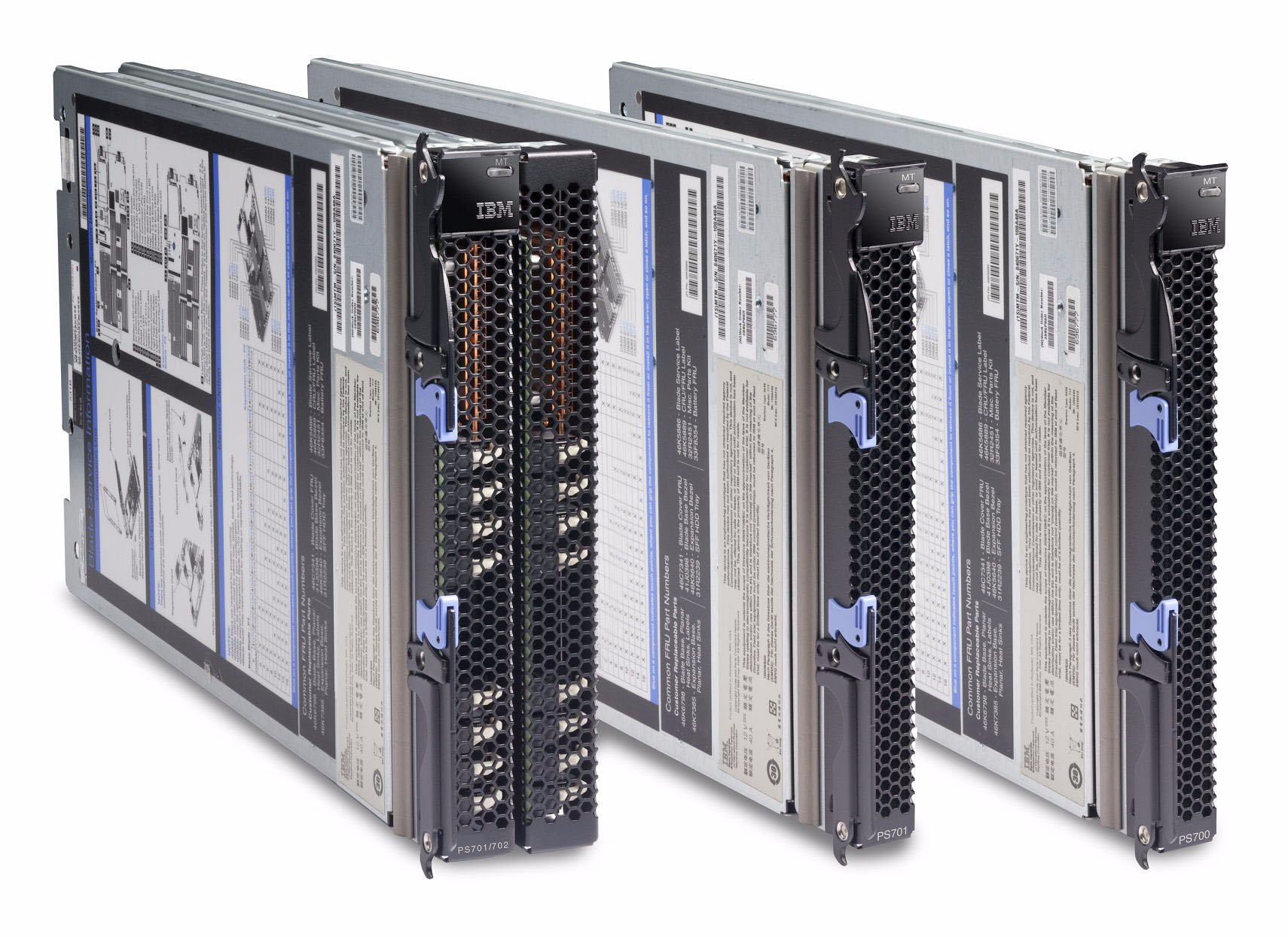
UPDATED 4/14/2010 –  IBM announced today their newest blade server using the POWER7 processor. The BladeCenter PS700, PS701 and PS702 servers are IBM’s latest addition to the blade server family, behind last month’s announcement of the BladeCenter HX5 server, based on the Nehalem EX processor. The POWER7 processor-based PS700, PS701 and PS702 blades support AIX, IBM i, and Linux operating systems. (For Windows operations systems, stick with the HS22 or the HX5.) For those of you not familiar with the POWER processor, the POWER7 processor is a 64-bit, 4 core with 256KB L2 cache per core and 4MB L3 cache per core. Today’s announcement reflects IBM’s new naming schema as well. Instead of being labled “JS” blades like in the past, the new POWER family blade servers will be titled “PS” – for Power Systems. Finally – a naming schema that makes sense. (Will someone explain what IBM’s “LS” blades stand for??) Included in today’s announcement are the PS700, PS701 and PS702 blade. Let’s review each.
IBM BladeCenter PS700
The PS700 blade server is a single socket, single wide 4-core 3.0GHz POWER7
processor-based server that has the following:
- 8 DDR3 memory slots (available memory sizes are 4GB, 1066Mhz or 8GB, 800Mhz)
- 2 onboard 1Gb Ethernet ports
- integrated SAS controller supporting RAID levels 0,1 or 10
- 2 onboard disk drives (SAS or Solid State Drives)
- one PCIe CIOv expansion card slot
- one PCIe CFFh expansion card slot
The PS700 is supported in the BladeCenter E, H, HT and S chassis. (Note, support in the BladeCenter E requires an Advanced Management Module and a minimum of two 2000 watt power supplies.)
IBM BladeCenter PS701
The PS701 blade server is a single socket, single wide 8-core 3.0GHz POWER7
processor-based server that has the following:
- 16 DDR3 memory slots (available memory sizes are 4GB, 1066Mhz or 8GB, 800Mhz)
- 2 onboard 1Gb Ethernet ports
- integrated SAS controller supporting RAID levels 0,1 or 10
- 2 1 onboard disk drive (SAS or Solid State Drives)
- one PCIe CIOv expansion card slot
- one PCIe CFFh expansion card slot
The PS701 is supported in the BladeCenter H, HT and S chassis only.
IBM BladeCenter PS702
The PS702 blade server is a dual socket, double-wide 16–core (via 2 x 8-core CPUs) 3.0GHz POWER7 processor-based server that has the following:
- 32 DDR3 memory slots (available memory sizes are 4GB, 1066Mhz or 8GB, 800Mhz)
- 4 onboard 1Gb Ethernet ports
- integrated SAS controller supporting RAID levels 0,1 or 10
- 2 onboard disk drives (SAS or Solid State Drives)
- 2 PCIe CIOv expansion card slots
- 2 PCIe CFFh expansion card slots
The PS702 is supported in the BladeCenter H, HT and S chassis only.
For more technical details on the PS blade servers, please visit IBM’s redbook page at: http://www.redbooks.ibm.com/redpieces/abstracts/redp4655.html?Open