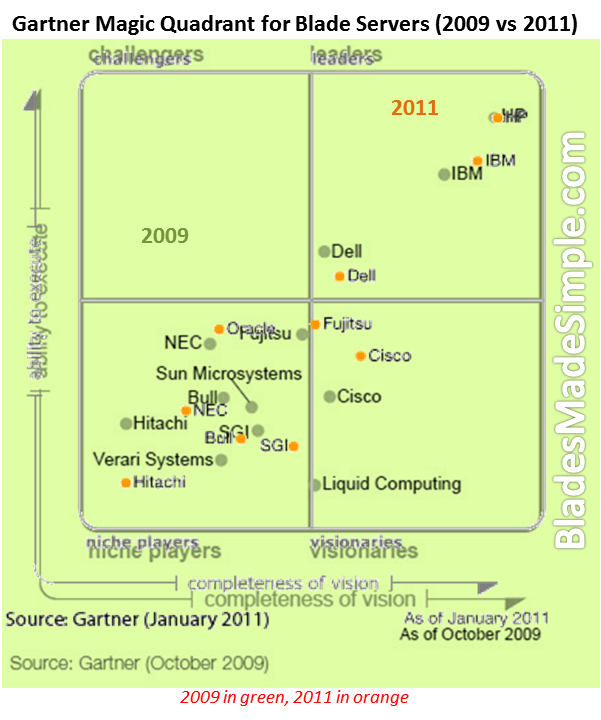
I was recently on one of those calls from HP “checking in”. If you are an HP customer you may know these calls start off with something like “We know you spent money on HP last quarter so how many people from this company will have to pester you until you buy more stuff from us?” One of the things the HP rep mentioned towards the end the process, however, is that until October HP is now offering a free blade enclosure with the purchase of four HP BL460’s. Continue reading
Category Archives: Cisco
Blade Chassis I/O Diagrams
Many people get confused as to why so many I/O modules are needed within a given blade chassis. The basic concept is simple (in most cases) – for each port you need on a given blade server, you need to have a corresponding I/O module. For example, if you need 4 NICs, you’re going to need 4 Ethernet modules (in most cases.) In today’s post, I thought I would keep it simple and publish the I/O diagrams of Cisco, Dell, HP and IBM chassis. Of course, I am human and “have been known to make mistakes – from time to time” so please feel free to correct me on any errors you see. Enjoy.
(Updated 8/3/2011 – fixed Dell M1000e Full Height I/O Diagram)
Comprehensive List of Blade Server Web Site Links
If you are like me, you are constantly referring to manufacture web sites for product specs, available options, etc. Today, I’ve put together a list of web sites that will help streamline your search. Since links change and new ones get added, I’ve put out a “helpful links” tab at the top of my blog as well for you to reference and bookmark. As I get recommendations from my readers, I’ll update the “helpful links” tab, so be sure to add it to your favorites. Continue reading
Cisco Finally Releases UCS Market Share Numbers
May 24, 2011 – IDC came out with their 1Q 2011 worldwide server market revenue report today showing that Cisco has finally entered the market standings with a 3rd place standing at 9.4% factory revenue share . IDC’s findings also showed that both HP and IBM decreased their blade server market share from Q4 2010. Continue reading
Are We Finally Getting Market Share Numbers for Cisco UCS?
If you’ve been reading this blog over the past six months, you’ll know that I’ve continued to bust on Cisco for not providing market share numbers after selling their UCS product line for two years. I believe the wait is now over.
This Day in History: "HP Claims Cisco UCS Will Be Dead in 1 Year"
“A year from now the difference will be (Cisco) UCS (Unified Compute System) is dead and we have had phenomenal market share growth in the networking space…And customers are thrilled and partners are making a lot of money.” – Randy Seidl, VP of the Americas, Enterprise Servers Storage and Networking, HP (April 26, 2010)
This was a quote found in CRN’s article a year ago, today, from Randy Seidl, HP’s senior vice president of the Americas, Enterprise Servers Storage and Networking, who was tasked in leading the charge against Cisco. Needless to say, it’s a year later, and Cisco UCS is still around but with much question around how much market share they own since they’ve yet to release market data to IDC or Gartner.
Cisco Refreshes UCS B440 M2 and B230 M2 with Intel Xeon E7
 Cisco announced today the refresh of their UCS B440 M2 and B230 blade servers with the newly announced Intel Xeon E7. Continue reading
Intel Announces New Xeon 4 Socket CPU (E7); Dell, HP and IBM Slated to Refresh Blades
UPDATED 11:30 a.m. EST (4/6/11) – Intel announced today the next version of their 4 socket chipset, known as “E7”. Previously known with the codename of Westmere EX, the newly released Xeon 7600 will be rebranded as the Intel Xeon E7. Continue reading
4 Socket Blade Servers Density: Vendor Comparison (2011)
Revised with corrections 3/1/2011 10:29 a.m. (EST)
Almost a year ago, I wrote an article highlighting the 4 socket blade server offerings. At that time, the offerings were very slim, but over the past 11 months, that blog post has received the most hits, so I figured it’s time to revise the article. In today’s post, I’ll review the 4 socket Intel and AMD blade servers that are currently on the market. Yes, I know I’ll have to revise this again in a few weeks, but I’ll cross that bridge when I get to it. Continue reading
Blade Server Market Share Comparison – Q3 2009 vs Q3 2010
I was updating a slide deck that I use to compare blade server technologies for customers when I came across the IDC and Gartner data from Q3 of 2009. I was very surprised at what I found out, so today’s post takes a look back at 2009 and compares it to 2010. Continue reading