Category Archives: HP-HPE

Interesting HP Server Facts (from IDC)

As you can see from my blog title, I try to focus on “all things blade servers”, however I came across this bit of information that I thought would be fun to blog.  An upfront warning – this is an HP biased blog post, so sorry for those of you who are Cisco, Dell or IBM fans.

Market research firm, IDC released a quarterly update to their Worldwide Quarterly Server Tracker, citing market share figures for the 3rd calendar quarter of 2009 (3Q09).  From this report, there are a few fun HP server facts (thanks to HP for passing these facts along to me:)

HP is the #1 vendor in worldwide server shipments for the 30th consecutive quarter (7.5 years). HP shipped more than 1 out of every 3 servers worldwide and captured 36.5 percent total unit shipment share.

According to IDC:

  • HP shipped over 161,000 more servers than #2 Dell.
  • HP shipped 2.6 times as many servers as #3 IBM
  • 9.0 times as #4 Fujitsu
  • 12.9 times as many as #5 Sun.
  • HP ended up in a statistical tie with IBM for #1 in total server revenue market share with 30.9 percent.  This includes all server (UNIX and x86 revenues.)

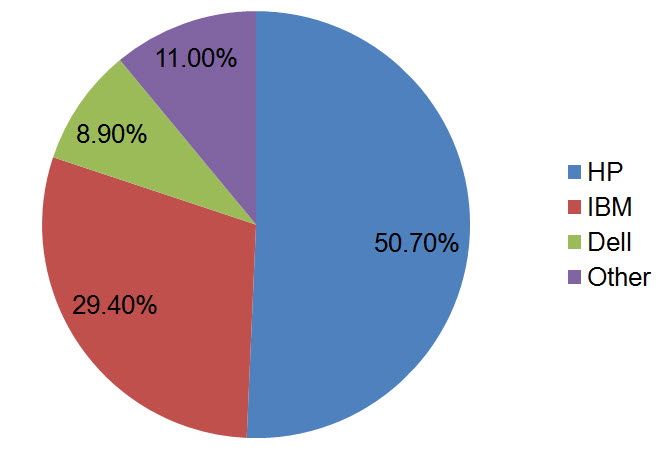
HP leads the blade server market, with a 50.7 percent revenue share, and a 47.7 percent unit share.
I blogged about this in early December (see this link for details),but it’s no surprise that HP is leading the pack in blade sales.  Their field sales team is actively promoting blades for nearly every server opportunity and they continue to make innovative additions to their blades (like 10Gb NICs standard on G6 blades.)   HP Integrity blades claimed the #1 position in revenue share for the RISC+EPIC blade segment with a 53.2 percent share gaining 1.8 points year over year.

For the 53rd consecutive quarter, more than 13 years, HP ProLiant is the x86 server market share leader in both factory revenue and units, shipping more than 1 out of every 3 servers in this market with a 36.9 percent unit share.

HP’s x86 revenue share was 14.6 points higher than its nearest competitor; Dell. HP’s x86 revenue share was 19.2 percentage points higher than IBM.

 For the 3 major operating environments UNIX®, Windows and Linux combined (representing 99.3 percent of all servers shipped worldwide), HP is number 1 worldwide in server unit shipment and revenue market share.

HP holds a 36.5 percent unit market share worldwide, which is 2.6 times more than IBM’s unit market share and 12.9 times the unit share of Sun.

HP holds a 35.4 percent revenue market share worldwide which is 2.2 times the revenue share of Dell and 4.0 times the revenue share of Sun.

FINAL NOTE:  All of the following market share figures are for the 3rd quarter (unless otherwise noted) and represent worldwide results as reported by the IDC Worldwide Quarterly Server Tracker for Q309, December 2009.
The Hit Movie, AVATAR Processed on HP Blade Servers

Since the hit movie AVATAR surpassed the $1 Billion Revenue mark this weekend I thought it would be interesting to post some information about how the movie was put together – especially since the hardware behind the magic was the HP BL2x220c.

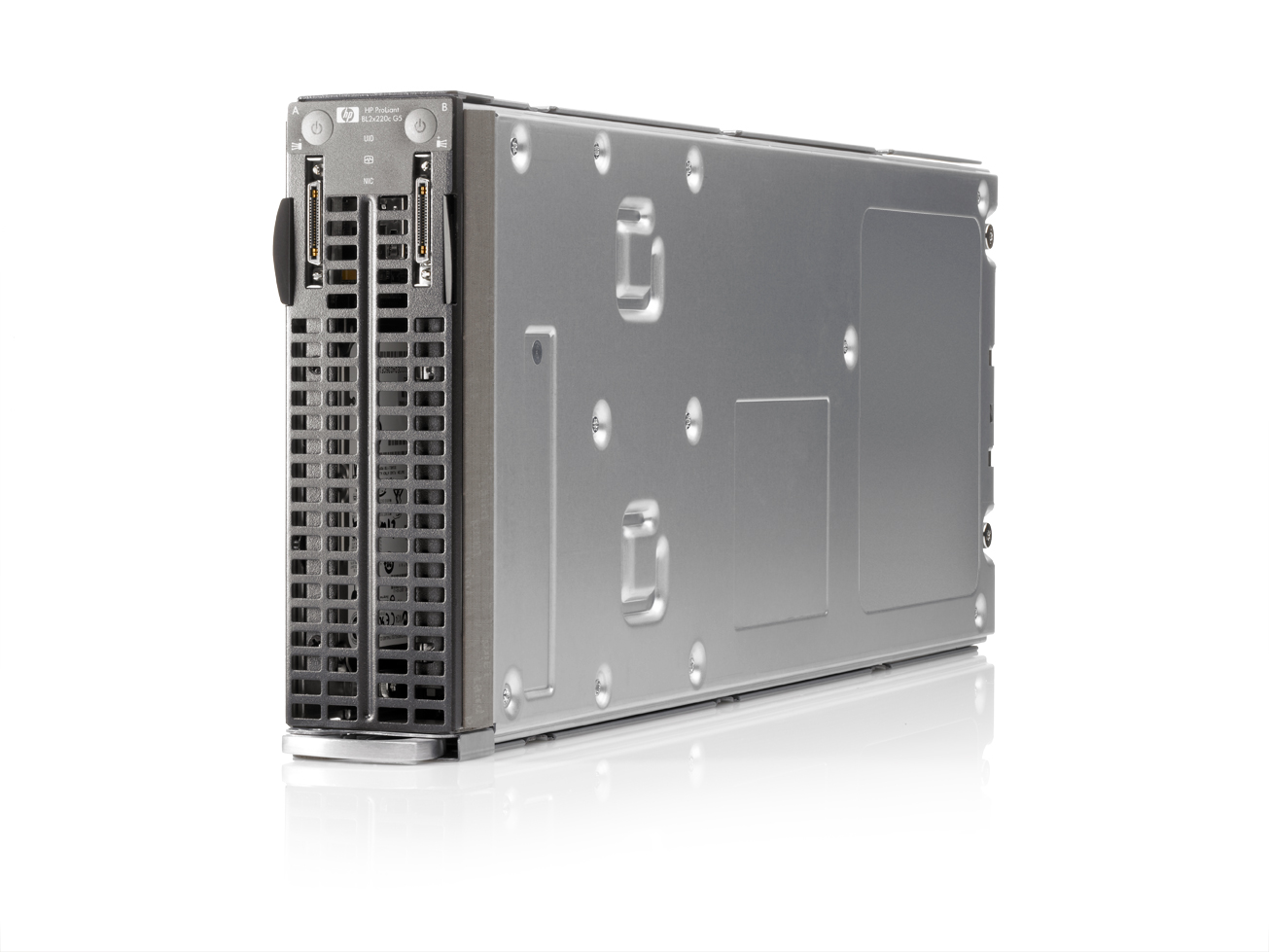
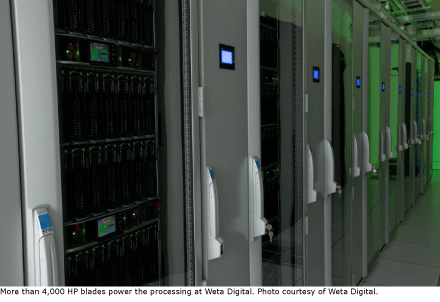
According to an article from information-management.com, AVATAR was put together at a visual effects production house called Weta Digital located in Miramar, New Zealand.  Weta’s datacenter sits in a 10,000 square foot facility however the film’s computing core ran on 2,176 HP BL 2x220c Blade Servers.  This added up to over 40,000 processors and 104 terabytes of RAM(Check out my post on the HP BL 2x220c blade server for details on this 2 in 1 server design by HP.)

The HP blades read and wrote data against 3 petabytes of fast fiber channel disk network area storage from BluArc and NetApp.  According to the article, all of the gear was  connected by multiple 10-gigabit network links. “We need to stack the gear closely to get the bandwidth we need for our visual effects, and, because the data flows are so great, the storage has to be local,” says Paul Gunn, Weta’s data center systems administrator.  

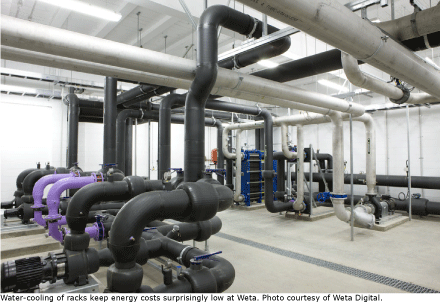
The article also highlights the fact that the datacenter uses water cooled racks to keep the racks and storage cooled.  Suprisingly, the water cooled design, along with a cool local climate, allows Weta to run their datacenter for less cost than running air conditioning (all they pay for is the cost of running water.)  In fact, they recently won an energy excellence award for building a smaller footprint that came with 40% lower cooling cost.

Summary of Hardware Used for AVATAR:

  • 34 racks – each with 4 HP BladeSystem Chassis, 32 servers (16 BL2x220c)
  • over 40,000 processors
  • 104 TB RAM

Since I don’t want to re-write the excellent article from information-management.com, I encourage you to click here to read the full article.

IDC Q3 2009 Report: Blade Servers are Growing, HP Leads in Shares

IDC reported on Wednesday that blade server sales for Q3 2009 returned to quarterly revenue growth with factory revenues increasing 1.2% year over year.  However there was a 14.0% year-over-year shipment decline.  Overall blade servers accounted for $1.4 billion in Q3 2009 which represented 13.6% of the overall server revenue.  Of the top 5 OEM blade manufacturers, IBM experienced the strongest blade growth gaining 6.0 points of market share.  However, overall market share for Q3 2009 still belongs to HP with 50.7%, with IBM following up with 29.4% and Dell in 3rd place with a lowly 8.9% revenue share.Q3_2009_Blades According to Jed Scaramella, senior research analyst in IDC's Datacenter and Enterprise Server group,  "Customers are leveraging blade technologies to optimize their environments in response to the pressure of the economic downturn and tighter budgets. Blade technologies provide IT organizations the capability to simplify their IT while improving asset utilization, IT flexibility, and energy efficiency.  For the second consecutive quarter, the blade segment increased in revenue on a quarter-to-quarter basis, while simultaneously increasing their average sales value (ASV). This was driven by next generation processors (Intel Nehalem) and a greater amount of memory, which customers are utilizing for more virtualization deployments. IDC sees virtualization and blades are closely associated technologies that drive dynamic IT for the future datacenter."

HP Unveils New Updated Blade Server: BL2x220c G6

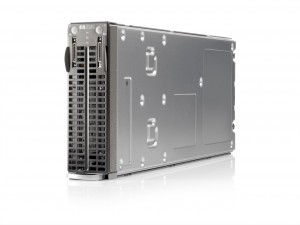
bl2x220cg5HP officially announced today an update to their BL2x220c blade server line.  Although the primary purpose for this update was to introduce the Intel Xeon 5500 Series processor to the server line, there are additional significant enhancements as well (shown below in bold:

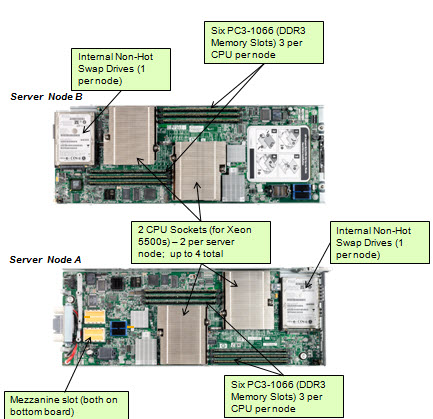
  • Up to two Quad-Core Intel® Xeon® 5500 sequence processors
  • Up to 48 GB (6 x 8 GB) of memory, supported by (6) slots of PC2-5300 Registered DIMMs, 1066Mhz
  • 1 non-hot plug small form factor SATA or Solid State hard drive
  • Embedded Dual-port NC326i Gigabit Server Adapter
  • One (1) I/O expansion slots via mezzanine card
  • One (1) internal USB 2.0 connector for security key devices and USB drive keys
  • Supported ONLY in c7000 Chassis

For those of you not familiar with the BL2x220 Blade Server, I think it is one of HP’s best kept secret.  BL2x220G6 - OpenThis blade server is an awesome feet of design because it is not just 1 server, it is 2 servers in 1 blade case – in a clam shell design (see below).  This means that in a HP C7000 BladeSystem chassis you could have 32 servers!    That’s 64 CPUs, 256 CORES, 3TB of RAM all in a 10U rack space.  That’s pretty impressive.

For more details on this new server, I encourage you to visit the QuickSpecs website at http://h10010.www1.hp.com/wwpc/us/en/sm/WF05a/3709945-3709945-3328410-241641-3722790-4047584.html


HP Converged Infrastructure

In the wake of the Cisco, EMC and VMware announcement, HP today is formally announcing the HP Converged Infrastructure.  You can take a look at the full details of this design on HP’s Website, but I wanted to try and simplify:

The HP Converged Infrastrcture is comprised of four core areas:

  • HP Infrastructure Operating Environment
  • HP FlexFabric
  • HP Virtual Resource Pools
  • HP Data Center Smart Grid

According to HP, achieving the benefits of a “converged infrastructure” requires the following core attributes:

  1. Virtualized pools of servers, storage, networking
  2. Resiliency built into the hardware, software, and operating environment
  3. Orchestration through highly automated resources to deliver an application aligned according to policies
  4. Optimized to support widely changing workloads and different applications and usage models
  5. Modular components built on open standards to more easily upgrade systems and scale capacity

Let’s take a peak into each of the core areas that makes up the HP Converged Infrastructure.

Operating EnvironmentHP Infrastructure Operating Environment
This element of the converged infrastructure provides a shared services management engine that adapts and provisions the infrastructure.  The goal of this core area is to expedite delivery and provisioning of the datacenter’s infrastructure. 

The HP Infrastructure Operating Environment is comprised of HP Dynamics – a command center that enables you to continuously analyze and optimize your infrastructure; and HP Insight Control– HP’s existing server management software.

FlexFabric

HP FlexFabric
HP defines this core area as  a “next-generation, highly scalable data center fabric architecture and a technology layer in the HP Converged Infrastructure.”  The goal of the HP FlexFabric is to create a highly scalable, flat network domain that enables administrators to easily provision networks as needed and on-demand to meet the virtual machines requirements. 

HP’s FlexFabric is made up of HP’s ProCurve line and their VirtualConnect technologies.  Beyond the familiar network components, the HP Procurve Data Center Connection Manager is also included as a fundamental component offering up automated network provisioning.

virtualResourcePools

HP Virtual Resource Pools
This core area is designed to allow for a virtualized collection of storage, servers and networking that can be shared, repurposed and provisioned as needed.

Most of HP’s Enterprise products fit into this core area.  The HP 9000 and HP Integrity servers use HP Global Workload Managerto provision workloads; HP Proliant servers can use VMware or Microsoft’s virtualization technologies and the HP StorageWorks SAN Virtualization Services
Platform
(SVSP) enables network-based (SAN) virtualization of heterogeneous disk arrays.

datacenter

HP Data Center Smart Grid
The goal of this last core area of the HP Converged Infrastructure is to “create an intelligent, energy-aware environment across IT and facilities to optimize and reduce energy use, reclaiming facility capacity and reducing energy costs.”

HP approaches this core area with a few different products.  The Proliant G6 server lines offer a “sea of sensors” that aid with the consumption of power and cooling.  HP also offers a Performance Optimized Datacenter (POD)– a container based datacenter that optimize power and cooling.    HP also uses the HP Insight Control software to manage the HP Thermal Logic technologies and control peaks and valleys of power management on servers.

Summary
In summary, HP’s Converged Infrastructure follows suit with what many other vendors are doing – taking their existing products and technologies and re-marketing them to closely align and reflect a more coherent messaging.  Only time will tell as to if this approach will be successful in growing HP’s business.

What is the HP BladeSystem Matrix?

hpmatrix-webHP announced a while ago a new product they call the HP BladeSystem Matrix.  Okay, well, it’s not really a “product” as much as it is a solution.  HP calls the BladeSystem Matrix “a cloud infrastructure in a box” – which is a good way to look at it.  The infrastructure that is “the Matrix” is simply HP’s BladeSystem chassis, loaded with blade servers and attached to an HP storage SAN.  Add to the mix some automation, via templates, and you have the BladeSystem Matrix.  The secret behind this unique solution is the “Matrix Orchestration Environment“, which combines automated provisioning, capacity planning, and disaster recovery, with a self-service portal into one “command center.”  However, this is not a single software, but a combination of HP Insight Dynamics – VSE and Insight Orchestration .

What’s In a BladeSystem Matrix?

There are two options for the HP BladeSystem Matrix bundle – a Starter Kit and an Expansion Kit.  The Starter Kit is designed to include all of the infrastructure necessary to manage up to 16 blade servers, with the option of adding a HP StorageWorks EVA4400 SAN.   The HP BladeSystem Matrix Starter Kit (hardware components) contains:

  • HP BladeSystem c7000 enclosure, single-phase, single-phase with 6 power supplies, 10 fans
  • HP BladeSystem c7000 Onboard Administrator with KVM option, redundant pair
    HP Virtual Connect Flex-10 10Gb Ethernet modules, redundant pair
    NOTE: No transceivers/SFPs included so that you can choose these options – need to add to order.
  • HP Virtual Connect 8Gb 24-Port FC Module for BladeSystem c-Class, redundant pair
    NOTE: Two [2] Fibre Channel SFP+ transceivers included with each module; therefore, 4 total transceivers per redundant pair.
  • BladeSystem Matrix documentation CD
  • BladeSystem Matrix label attached to 10000 series rack door handle

The part number for HP BladeSystem Matrix Starter Kit (hardware components) is 535888-B21. It is important to note, the starter kit does not contain any blade servers or storage.  Those must be ordered separately.

The HP BladeSystem Matrix Starter Kit (software components) provides HP Insight software licenses for 1 enclosure / 16-server with standard 1 year 24×7 Technical Support and Update Service unless 3-, 4-, or 5-year Support Plus 24 Care Pack uplifts are purchased to increase support and update period. These licenses include:

  • Insight Dynamics – VSE suite for ProLiant with Insight Control suite
  • Insight Orchestration software
  • Insight Recovery software
  • Virtual Connect Enterprise Manager software
  • HP Insight Remote Support Advanced (formerly Remote Support Pack)

The part number for HP BladeSystem Matrix Starter Kit (software components) is TB462A.

Once you have the Hardware and Software Starter kits, then you’ll need to purchase the HP Professional Services – for installation; the Central Management Server (CMS) – a BL460 with 2 CPUs, 12GB RAM; additional blade servers and the storage that you need.

The HP BladeSystem Matrix Expansion Kit (HP part #507021-B21 ) is very similar to the Starter Kit:

  • HP BladeSystem c7000 enclosure, single-phase, single-phase with 6 power supplies, 10 fans
  • HP BladeSystem c7000 Onboard Administrator with KVM option, redundant pair
    HP Virtual Connect Flex-10 10Gb Ethernet modules, redundant pair
    NOTE: No transceivers/SFPs included so that you can choose these options – need to add to order.
  • HP Virtual Connect 8Gb 24-Port FC Module for BladeSystem c-Class, redundant pair
    NOTE: Two [2] Fibre Channel SFP+ transceivers included with each module; therefore, 4 total transceivers per redundant pair.
  • BladeSystem Matrix documentation CD
  • BladeSystem Matrix label attached to 10000 series rack door handle

However, it also includes software licenses for:

  • Insight Dynamics – VSE suite for ProLiant with Insight Control suite
  • Insight Orchestration software
  • Insight Recovery software
  • Virtual Connect Enterprise Manager software
  • HP Insight Remote Support Advanced (formerly Remote Support Pack)

Once again, you’ll need to purchase the HP Professional Services – for installation; then your blade servers and the storage that you need.

As you can see, the HP BladeSystem Matrix is not a new product – it is an easy way to order HP BladeSystem products and use HP services and software to easily get your server infrastructure in place.  Let me know your thoughts – feel free to leave comments.  For more on the HP BladeSystem Matrix, visit HP’s web site at http://h18004.www1.hp.com/products/blades/components/matrix/main.html

HP's Well Hidden Secret Blade Server

bl2x220cg5

BL2x220c G5 (2 server "nodes" shown)

HP’s BladeSystem server offering is quite extensive – everything from a 4 CPU Intel blade to an Itanium CPU blade, however their most well hidden, secret blade is their BL2x220c blade server.  Starting at $6,129, this blade server is an awesome feet of design because it is not just 1 server, it is 2 serversin 1 blade case – in a clam shell design (see below).  This means that in a HP C7000 BladeSystem chassis you could have 32 servers!    That’s 64 CPUs, 256 CORES, 2TB of RAM all in a 10U rack space.  That’s pretty impressive.  Let me break it down for you.  Each “node” on a single 2 node BL2x220c G5 server contains:

  • Up to two Quad-Core Intel® Xeon® 5400 sequence processors
  • Up to 32 GB (4 x 8 GB) of memory, supported by (4) slots of PC2-5300 Registered DIMMs, 667 MHz
  • 1 non-hot plug small form factor SATA or Solid State hard drive
  • Embedded Dual-port NC326i Gigabit Server Adapter
  • One (1) I/O expansion slots via mezzanine card
  • One (1) internal USB 2.0 connector for security key devices and USB drive keys

BL2x220


You may have noticed that this server is a “G5” version and currently has the older Intel 5400 series processors.  Based on HP’s current blade offering, expect to see HP refresh of this server to a “G6” model that will contain the Intel® Xeon® 5500 series processors.  Once that happens, I expect for more memoryslots to come with it, since the Intel® Xeon® 5500 series processors have 3 memory channels.  I’m guessing 12 memory slots “per node” or 24 memory slots per BL2x220c G6.  Purely speculation on my part, but it would make sense.  

Why do I consider this server to be one of HP’s best hidden secrets?  Simply because with that amount of server density, server processing power and server memory, the BL2x220c could become a perfect virtualization server.   Now if they’d only make a converged network adapter (CNA)…