The International Data Corporation’s (IDC) released their Worldwide Quarterly Server Tracker today covering Q4 2011. Despite a 7.2% decrease in the worldwide server factory revenue, the blade market continued to experience growth in 4Q11 with factory revenue increasing 8.3% year over year. Other key facts from the IDC press release: Continue reading
Tag Archives: blade server
Dell Announces New Blade Server – M620
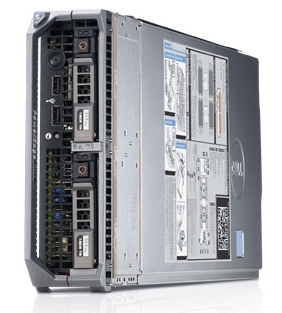
In anticipation of Intel’s upcoming E5-2600 CPU (aka Sandy Bridge) announcement, Dell officially announced the 12th Generation of PowerEdge servers today. Although the specifics of the 12th Generation, or “12G”, servers have not yet been released, it is very clear there will be a new blade server added to the Dell PowerEdge portfolio: the M620.
While Dell.com announcement site does not have a lot of the details of what’s coming in 12G, The Register has been able to secure some good information on the Dell PowerEdge M620 blade server that I’ll share with you.
- The M620’s size is “half-height”allowing you to put up to 16 inside of the Dell PowerEdge M1000e chassis.
- It will hold up to 2 x Intel Xeon E5 CPUs
- It will hold up to 768GB of RAM (the same as its tower and rack equivalent)
- The M620 has two hot-plug, 2.5-inch drive bays, and can have SSD, SATA disk, or SAS disk drives slid into those two slots.
- The PERC S110 controller with software raid and the PERC H310, H710, and H710P controllers for internal RAID arrays can snap onto this M620 blade.
- The M620 has two SD cards for redundant embedded hypervisors to sit on.
Of course, there are a few other goodies that The Register didn’t mention – so I’ll hold off talking about until the official Intel announcement.
To read the full article from The Register discussing the next generation of Dell PowerEdge server (including the tower and rack models,) go to http://www.theregister.co.uk/2012/02/27/dell_poweredge_12g_server_launch/
Kevin Houston is the founder and Editor-in-Chief of BladesMadeSimple.com. He has over 15 years of experience in the x86 server marketplace. Since 1997 Kevin has worked at several resellers in the Atlanta area, and has a vast array of competitive x86 server knowledge and certifications as well as an in-depth understanding of VMware and Citrix virtualization. Kevin works for Dell as a Server Specialist covering the Global 500 East market.
Photo from Dell.com
Where Did Blade Servers Come From?
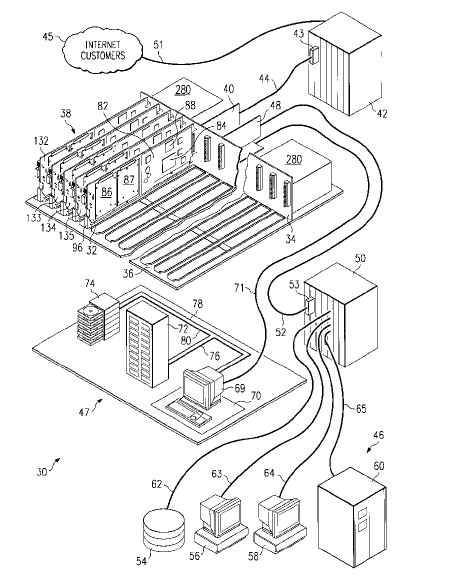 As I mentioned yesterday, one of my fellow bloggers, Stephen Foskett, is writing a series on blade servers. His latest post reveals the history of the blade server. Stephen’s article challenged me to do some research of my own – and here’s what I found. Apparently the first “official” patent for a server on blade (patent # 6,411,506 – “High density web server chassis system and method) was awarded in June of 2002 to Christopher G. Hipp and David M. Kirkeby of RLX Technologies. One interesting fact is that U.S. Patents referenced within the document refers to other patents from many leaders of the industry including IBM, Hewlett-Packard, Micron, Hitachi and even Dell.
I’ve taken the liberty of downloading the entire patent document for your reference:
High Density Web Server Chassis – Patent 6411506 B1 (1.84Mb, PDF).
If you like technology and are a history buff, I recommend you check out Stephen’s article at http://blog.fosketts.net/2012/02/20/blade-server-history/.
Kevin Houston is the founder and Editor-in-Chief of BladesMadeSimple.com. He has over 15 years of experience in the x86 server marketplace. Since 1997 Kevin has worked at several resellers in the Atlanta area, and has a vast array of competitive x86 server knowledge and certifications as well as an in-depth understanding of VMware and Citrix virtualization. Kevin works for Dell as a Server Specialist covering the Global 500 East market.
What Is a Blade Server?
 My friend, Stephen Foskett, is writing a series of posts introducing blade servers. It’s probably something I should have done a long time ago, but since I’m a slacker and he beat me to it, I’ll give him kudos and do a re-post. I encourage you to read the full article as it’s very enlightening. Here is an excerpt:
“I’ve been watching enterprise IT for over 20 years now, and I’ve seen some radical changes. In the server space, one of the biggest shifts was the form factor of the servers: From tower to rack-mount to blades. But what makes a blade server anyway? Let’s consider this for a moment, as we watch another shift in progress. Blade servers are easily recognized in the data centers, trade shows, and product catalogs of today: They’re the ones that nestle together in an enclosure, sharing some resources rather than standing on their own in a rack or on the floor. But what is the essential element that separates a blade from any other kind of server?”
Read the rest at http://blog.fosketts.net/2012/02/18/blade-server/
Kevin Houston is the founder and Editor-in-Chief of BladesMadeSimple.com. He has over 15 years of experience in the x86 server marketplace. Since 1997 Kevin has worked at several resellers in the Atlanta area, and has a vast array of competitive x86 server knowledge and certifications as well as an in-depth understanding of VMware and Citrix virtualization. Kevin works for Dell as a Server Specialist covering the Global 500 East market.
Cisco To Launch Next Generation UCS Blade Servers on March 6, 2012
According to a recent event posting by Cisco, the 3rd generation of Cisco UCS blade servers will be revealed on March 6, 2012. The server launch event advertises that Cisco will announce the B200 M3 blade server, and C220 M3, and C240 M3 rack servers on March 6th, 2012. These soon-to-be-announced servers are 2 socket servers built on Intel’s upcoming E5-2600 Romley processors and Patsburg chipsets.
Kevin Houston is the founder and Editor-in-Chief of BladesMadeSimple.com. He has over 15 years of experience in the x86 server marketplace. Since 1997 Kevin has worked at several resellers in the Atlanta area, and has a vast array of competitive x86 server knowledge and certifications as well as an in-depth understanding of VMware and Citrix virtualization. Kevin works for Dell as a Server Specialist covering the Global 500 East market.
Own a Piece of World of Warcraft
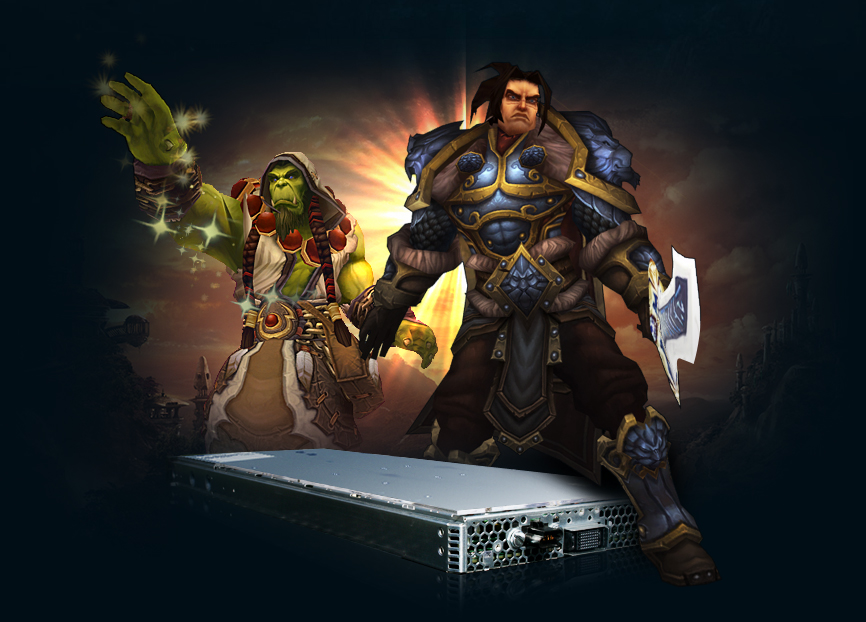
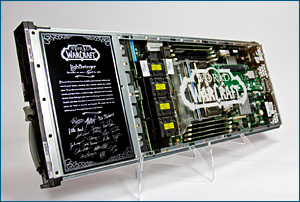
Blizzard Entertainment recently announced they are auctioning off some older HP blade servers that previously hosted the popular World of Warcraft (WoW) game with 100% of the proceeds going to St. Jude Children’s Research Hospital®. While it is great to own a piece of WoW history, keep in mind, these servers won’t do you any good for use without a minimum of a HP BladeSystem chassis, power supplies and ethernet modules. Here are the details of the auctions found at http://stores.ebay.com/Blizzard-Blade-Servers:
- Display is approximately 28” x 10.3” x 1.7” and weighs 18lbs.
-
Each case is exactly the same for all blade servers being auctioned.
-
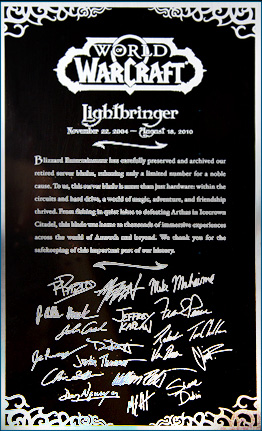
Plaques will show the Realm Name and Mo/Yr of start and end date.
-
The copy on the plaque varies. An example of one reads: Blizzard Entertainment has carefully preserved and archived our retired server blades, releasing only a limited number for a noble cause. To us, this server blade is more than just hardware: within the circuits and hard drive, a world of magic, adventure, and friendship thrived. From fishing in quiet lakes to defeating Arthas in Icecrown Citadel, this blade was home to thousands of immersive experiences across the world of Azeroth and beyond. We thank you for the safekeeping of this important part of history.
-
The signatures are printed on the plaque are not original and include the World of Warcraft team.
Current bids range from $107 to $225. Details of the blade server configuration is not provided, however I would speculate, 2 x Intel 5400 CPUs with 64GB of RAM and 6 Network Interface Cards (NICs.) UPDATE – one of our readers, Marrtins, commented below that he received a response from the auction that, “I apologize but these server blades are non-working. All memory has been wiped and they are non-functioning. They are strictly pieces of art.”
The auction runs through January 30, so go to http://stores.ebay.com/Blizzard-Blade-Servers and place your bids while you can!
Kevin Houston is the founder and Editor-in-Chief of BladesMadeSimple.com. He has over 15 years of experience in the x86 server marketplace. Since 1997 Kevin has worked at several resellers in the Atlanta area, and has a vast array of competitive x86 server knowledge and certifications as well as an in-depth understanding of VMware and Citrix virtualization. Kevin works for Dell as a Server Specialist covering the Global 500 East market.
HP Flex 10 vs VMware vSphere Network I/O Control for VDI
I once was a huge fan of HP’s Virtual Connect Flex-10 10Gb Ethernet Modules but with the new enhancements to VMware vSphere 5, I don’t think I would recommend for virtual environments anymore. The ability to divide the two onboard network cards up to 8 NICS was a great feature and still is, if you have to do physical deployments of servers. I do realize that there is the HP Virtual Connect FlexFabric 10Gb/24-port Module but I live in the land of iSCSI and NFS so that is off the table for me.
With vSphere 5.0, VMware improved on its Continue reading
Why Blade Servers Will be the Core of Future Data Centers
In 1965, Gordon Moore predicted that engineers would be able to double the number of components on a microchip every two years. Known as Moore’s law, his prediction has come true – processors are continuing to become faster each year while the components are becoming smaller and smaller. In the footprint of the original ENIAC computer, we can today fit thousands of CPUs that offer a trillion more computes per seconds at a fraction of the cost. This continued trend is allowing server manufactures to shrink the footprint of the typical x86 blade server allowing more I/O expansion, more CPUs and more memory. Will this continued trend allow blade servers to gain market share, or could it possibly be the end of rack servers? My vision of the next generation data center could answer that question.
Dell Network Daughter Card (NDC) and Network Partitioning (NPAR) Explained
If you are a reader of BladesMadeSimple, you are no stranger to Dell’s Network Daughter Card (NDC), but if it is a new term for you, let me give you the basics. Up until now, blade servers came with network interface cards (NICs) pre-installed as part of the motherboard. Most servers came standard with Dual-port 1Gb Ethernet NICs on the motherboard, so if you invested into a 10Gb Ethernet (10GbE) or other converged technologies, the onboard NICs were stuck at 1Gb Ethernet. As technology advanced and 10Gb Ethernet became more prevalent in the data center, blade servers entered the market with 10GbE standard on the motherboard. If, however, you weren’t implementing 10GbE then you found yourself paying for technology that you couldn’t use. Basically, what ever came standard on the motherboard is what you were stuck with – until now.
Why Are Dell’s Blade Servers “Different”?
I’ve learned over the years that it is very easy to focus on the feeds and speeds of a server while overlooking features that truly differentiate. When you take a look under the covers, a server’s CPU and memory are going to be equal to the competition, so the innovation that goes into the server is where the focus should be. On Dell’s community blog, Rob Bradfield, a Senior Blade Server Product Line Consultant in Dell’s Enterprise Product Group, discusses some of the innovation and reliability that goes into Dell blade servers. I encourage you to take a look at Rob’s blog post at http://dell.to/mXE7iJ. Continue reading